Showing posts with label Fuzzrite. Show all posts

Saturday, January 4, 2014

The Rites of Fuzz - The Ritefuzz: revisited and enhanced


The Green Spirit FuzzRite clone
Ever since I started this blog I had this sound in my mind which I knew I just have to understand. I was always attracted to those elusive grainy buzz stutters of the early fuzzes. The problem with early fuzzes is that no one really knows what really happened in those studios back then.
Even after devouring every piece of information on the web, there are some unsolved mysteries regarding who used what and how and exactly when. The combinations are endless with the amount of differences the guitars, pedals and amps had back then. Transistors and components changed a lot and a lot of the stuff was customized.
As an example, think of the "Spirit in the Sky" by Norman Greenbaum which played a modified Tele with a fuzz circuit build inside the guitar, or the sound of Davie Allen and the Arrows which used parked wah in front of his Fuzz like Mick Ronson during the Spiders era. If you really want to understand those sounds, you have to start buying or building stuff.

Well, some of the best fuzz sounds ever recorded were never really confirmed as to how the sound was created. When I started building stuff, one of my first fuzz builds was the Orpheum Fuzz which was a simple silicon version which I decided to box. The sound was so far out and I really got to hear my guitar play Sky Saxon's incredible fuzz sound which was so sax-like. I was in heaven. Today I can really verify that the Orpheum Si fuzz played with a tele, volume knob a bit low, and through a VOX AC30 amp or sim cab, can be amazingly close to the sound I was after. I guarantee anyone who loves those ripped mid 60's garage sound will love this combination. It beats the Jordan Bosstone by a 1000 miles.

Yet, the Orpheum is so far out, that it won't give you the end of the scale which is Ennio Morricone's classic spaghetti western fuzz. For that you probably need a Mosrite Fuzzrite or a Maestro Fuzz Tone, and yes, you still need a tele and a Vox cab.

So I built the RFNR Green Bomb which was great but in 2 years of having it, I never really played it live a lot and I always ended up using the mighty Orpheum. After revisiting the circuit for the 20th time I finally ran into the John Kallas modded version which implemented some enhanced features. Now, the Fuzzrite is such a simple circuit that it would be really hard to achieve all those sounds in my head without some additions which would only do the circuit justice.

So, the simple circuit, shown below, just goes to show how closely related all these garage fuzz schemes. A few value changes can have a strong effect with such a small part count Although very close to the Fuzzrite design, the Orpheum is a much stronger design with many similarities in sound to the Shinei Fuzz Companion FY-2. If you ever run into Psycho Candy by Jesus and the Mary Chain, you'll notice right at the first chord the FY-2. If you like the Ventures, Dick Dale, The seeds, The Stooges and Garage Psych in general, 80% of these bands, I guess played a Fuzzrite at some point between 1966-1969.

Variations on the basic Fuzzrite design from the Aronnelson gallery

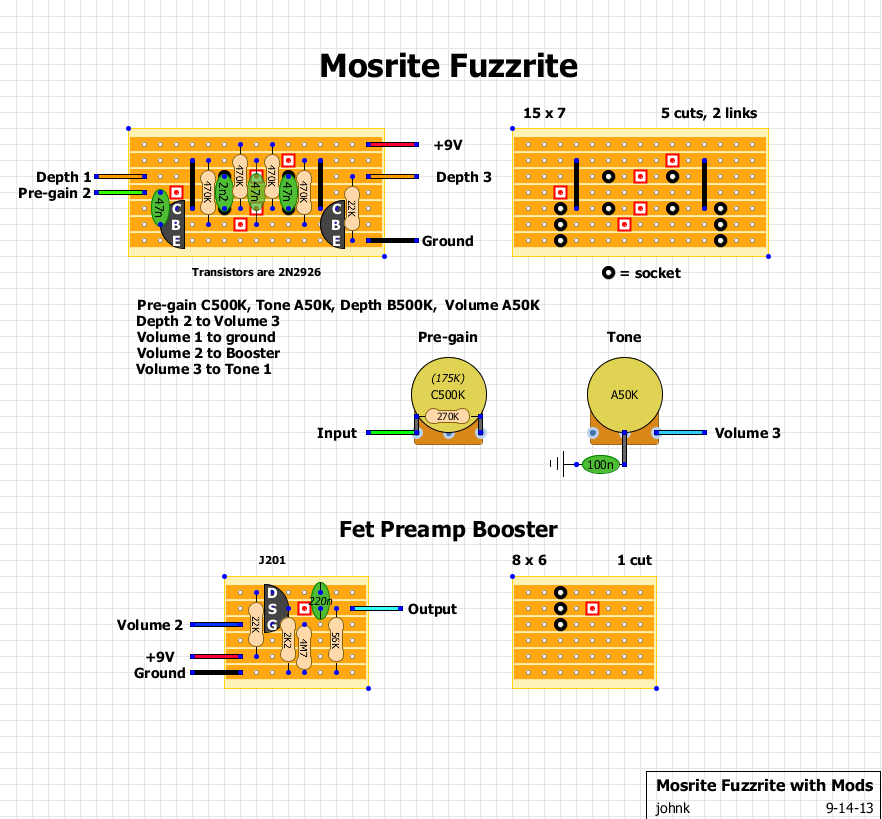
I ended up ripping the guts out of my Green Spirit (RFNR Green Bomb) and replacing it with a true Fuzzrite and then added the mods recommended by John Kallas. These are basically
  1. 22k resistor from 2n2 tone cap to ground.
  2. An extra TONE pot with a 100n cap to control the highs (seems that I like this pot cranked most of the time).
  3. An added J201 gain stage to bring the volume back up at the end of the circuit so you easily get unity volume.
  4. A higher cap value on a switch so that the DEPTH/FUZZ pot can yield fuller and fatter sound.
  5. An extra pot for PREGAIN which helps getting the sound of a lowered guitar volume knob.

The John Kallas version can be found here:

And, of course, it is always worth to visit the great layouts by Mark and Mirosol on TagboardFX blog: http://tagboardeffects.blogspot.co.il/2010/07/mosrite-fuzzrite.html


That's what I really love about building fuzz circuits. Getting the best possible design is part of the fun. So now I have a new Green Spirit, named after Greenbaum and his Spirit in the Sky guitar tone. I could have easily found 10 different names for that pedal based on the words Hoodoo, Seeds, Ventures, Misirlou, Spaghetti Westerns, Devil's Rumble and the list goes on.

In the demo below I simply played around with the knobs to get some of the tones I was looking for. 2 2N222A trannies were used because the original 2N2926 NPN trannies haven't arrived yet and I couldn't wait. A tele and a VOX AC30 cab sim at both ends of this wonderful beast with some added fender '63 style spring reverb. 

Don't miss out on this one. If you have to build one fuzz to rule them all, one fuzz for all your crazy 60's aspirations, one fuzz - grainy and harsh, buzzy and saxy, zippy and gnarly then this is IT !!! Even the "Satisfaction" riff sounds amazing with this pedal. Don't believe me? check out the demo and skip to 14:36.


Sunday, April 22, 2012

The Rite Fuzz for Buzz

The Green Spirit FuzzRite clone
So after a few circuits on the breadboard and a lot of listening and reading I started realizing what the Fuzz is all about....what it is.....and what is should never be!


Fuzz is all about clipping. Not soft clipping like a tube amp or like what we call today 'Overdrive'. Fuzz is about hard clipping. The saturation is immediate and pushed so hard that you get a lot of sustain due to over compression into saturation. The effect of feedbacking a  2nd transistor back into a 1st gain transistor drives the circuit into this hard clipping. Si vs. Ge, architecture and design are all important factors.

When I first heard Garage bands like Strawberry Alarm Clocks,  The Seeds (Evil Hoodoo and Pushing Too Hard) and The Sonics, I didn't really know what was so special about their guitar sound. But when I heard Norman Greenbaum's Spirits in the Sky, The Venture's 2000 pound Bee and Buffalo Springfield's Mr Soul, I realized what to look for. It's that BUUUUZZZZZ. It's a sound that sounds so rotten and crushed that it can be nothing but a fuzz. It really sounds like a bad mixer channel or like the speakers were slashed (that's how they first did it).

The Green Spirit is a super usefull FuzzRite workhorse
Once you start listening to the sound of the Fuzz you start hearing the little differences and before you know it you want 10 different kind of pedals. But the problem isn't the pedals, it's the fact that building them takes a lot of time and for a while you really just plan on playing music but you never do 'cause you are always after the next elusive pedal.


The Mosrite Fuzzrite was a classic buzz maker after the success of the first Maestro Fuzz-Tone. The pedal was heavily used between 1966 and 1969 before Fuzz Faces and Big Muffs took over. It's harshness cannot be mistaken and it sounds close to the previously discussed Orpheum. I looked for a Fuzzrite version which would be easy to build and mod, versatile and authentic sounding. The RNFR Green Bomb seemed like a good choice and once I chopped the first chord I knew what to call it. I added a switch to change four caps simultaneously and get that very thin fuzz but other than that it's really the Green Bomb. The buzz is superb and really gives you that Spirits in the Sky effect. I really love this pedal and the sound takes just me back every time. Good with a Vox or a Fender sounding amp pedal just after it. A real candidate for the FuzzQuest all time favorite. You can find the schematic by RNFR here.


Wednesday, April 11, 2012

Orpheum Fuzz

The Orpheum Fuzz - Thanks Andrew Carrell whoever you are
This mean and nasty fuzz is somewhere between the Shin-Ei Fuzz Companion and the Mosrite Fuzzrite. It's buzzy and zippy all at once and really does that 1966 sax-like buzz in a very convincing manner.

I built it because I was looking for that elusive mid 60's fuzz which is both thick and buzzy like that found on Garage Psych albums by west coast bands like the Seeds or Strawberry Alarm Clocks. The first feedback I got on the web stated I should go for a Mosrite Fuzzrite sound or something similar. Finding a simple schematic using Silicon transistors I gave it shot. It's a silicon fuzz and I tried several silicon trannys until I found the right combination. Well I have to admit it...IT SOUNDS GREAT, both on guitar and bass. Beautiful on single coils and Humbuckers. I really nailed the Spirit in the Sky buzz sound by finger picking with the Neck pickup.

The only addition I added was a 68k resistor in series with the 199nF cap at the input to tame the fuzz for humbuckers and to have some extra control on the pedal which simulates the effect of rolling off the guitar's volume knob a bit. This is a great mod and could be hooked up on an SPST switch to enable both options.

After some years building all kinds of ancient fuzz circuits I can definitely say that this circuit delivers some crazy vintage sounds which you wouldn't get from any other pedal. Very buzzy-zippy-sax-like in your face fuzz. NOT for chords but more for those wacky 60's solos and heavy riffs. Amazing on bass and on guitars on the neck pickup. It's that simple....and that rewarding. Mean, splatty and nasty!

Other garage riffs and solos which can be nailed are those by the Seeds. Mellow playing with your thumb on the lower strings with the neck pickup really brings out the buzziness in a beautiful way.

The Orpheum Fuzz
The TONE control really changes the character of the sound and goes from fat crunch to mean sharp buzz. On neck pickup and playing lower strings with your fingers you get amazing sax-like character which is exactly what I was looking for. It's meaner than the Mosrite but not as aggressive as the Shin-Ei. It's just the perfect balance between the two. I love it!!!

Both 2N2222A and 2N3904 as well as Silicon NPNs should sound good as long as the Hfe is around 100-300, I guess. I started with the 2N2222A which sounded great but then moved to 2N3904 which had a bit more gain and gave me more flexibility at lower settings.

If you wanna build the germanium version you can find the schematic here:

The great layouts by Dragonfly can be found on the aronnelson page here:  http://www.aronnelson.com/gallery/main.php/v/DRAGONFLY-LAYOUTS_0/album18/FUZZ+PCB/ORPHEUM+OLD+SCHOOL+LAYOUT.GIF.html?g2_imageViewsIndex=1

The no-risk versions from the TagboardFX page:
http://tagboardeffects.blogspot.co.il/2012/12/orpheum-fuzz.html

The Schematic I used for the silicon version is no longer available for some reason on the web so I am adding it here if Dragonfly doesn't mind:
Orpheum Silicon fuzz version
A fascinating comparison between some vintage fuzz circuits which are all based on similar architecture with minor differences can also be found here.

Will soon add a clip to demo this beast.

The Colors I use for painting all enclosures on this blog.
I like the paint job I did. It was my first attempt at doing my own art on these pedals and once I saw the result I never looked back and went on doing the art on all my future pedals.

I tried to find a different name for it as I couldn't understand why they named it Orpheum. It should have been called something like Morpheum.

Highly recommended for any newbee in the DIY business. Easy to build and tune and sounds really authentic and musical.