 |
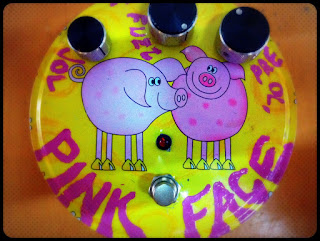
| The Pink Face |
Throughout the history of fuzz pedals, fuzz guitarists and psychedelic fuzzy solos, there is no fuzz which has received greater attention than the legendary Fuzz Face. Originally produced by Arbiter Electronics in England and appeared during 1966 the unit was an immediate success. Many of the greatest guitarists in rock history played their best solos and riffs through a Fuzz Face including Hendrix, Gilmour, Blackmore, Harrison, Townsend and many more. Nevertheless, the dependency of the Germanium transistors on temperature resulted in a lack of tone consistency and many players suffered on stage from this effect. To circumvent this issue Dallas Arbiter started issuing Silicon versions of the FF somewhere around 1969 replacing the NKT275 trannies with BC108. Silicon was the new hype at the time and it seemed that by 1970-71 everybody was switching to Silicon faces. Hendrix's Band of Gypsys, Gilmour on all PF albums and tours since 1971 including all of the solos on Meddle and Dark side of the Moon are probably the most documented examples. One of my favorite guitarists Michael Karoli (Can) also used Silicon Fuzz Faces to create his raw and untamed distortion throughout the history of Can, so this was enough to get me going.
Both designs are pretty close with the Germs being mostly PNP and the Silis being NPN. Comparing the sound of the Germanium units with the Silicon ones it is often said that while the Germs sound raspy, warm and sweet, the Silicons are brighter, edgy and have more gain. Well....from my builds....this statement is....TRUE!
 |
| The original 1966 Arbiter Face - Germanium |
On my Fuzz quest I really couldn't imagine the journey without understanding the differences between the two FF versions and there was no other way than building the two. After I finished the Germanium Fulltone version I started to drown with info on the Silicon versions: Fulltone, Analog Man, Dunlop, Runoffgroove, GGG you name it. I looked through dozens of schematics and breadboarded some of them. I even looked at the German Schaller Fuzz (FF variant) after reading that Michael Karoli (CAN) used one. Actually, the first fuzz I ever built was the Runoffgroove SiliFace II and I loved it for some months. That was what got me interested in fuzz pedals in the first place, My Fuzz quest started because one fuzz was not enough to get the range of buzz tones I was after.
 |
| The 1970 Dallas Arbiter Fuzz Face - Silicon |
Due to the fact that the Fuzz Face design is tolerant to part values many versions have been issued over the years and the amount of Fuzz Face versions became quite vast (just like it happened with the Big Muffs or the Tube Screamers). The design is so simple that small part changes resulted in some sonical change. After all the entire unit incorporates 4 resistors, 3 caps, 2 transistors, 2 pots and 1 switch. That's it!
 |
| 4 resistors, 3 capacitors, 2 transistors, 2 potentiometers |
The sound I was aiming for was that of Gilmour playing the Time solo on the album version of the Dark Side. I started out with the GGG early 70's Boutique NPN Fuzz Face after my success with the GGG 60's version. I liked the PRE GAIN knob and the circuit seemed pretty good, but something was missing. I didn't box the circuit and it stayed on the shelf for some time. I built a few other Fuzz pedals and when I thought I understood more about what I wanted I revisited the circuit. This time I modified the circuit based on the Axis Face version by Phillip Bryant modified by Brett Robinson.
 |
| Gilmour's early 70's rig |
I did a lot of testing using Hi-Watt amp emulations, tweaked many of the parts in this little circuit, changed trannies and used several guitars. Surprisingly, I ended up using 2N2369 (hfe=70-90) for Q1 and BC109 for Q2 (hfe=200). The BC108C I had (hfe around 400-550) seemed to be too pumped up for my taste. I settled on a 50kA pot for the PRE GAIN and a 100kA for the VOLUME. 220n cap for the input and 30p cap on the bridge for lo-pass filtering. I replaced the CONTOUR pot with a 470R resistor and kept the 22uF Fuzz cap. I kept the reverse polarity protection and cut off the strange feedback diode bridge which didn't seem to affect the sound. Biasing Q2 I got 4.5V with resistance being about 3k3 so that's about 4k3 total Q2 bias. It's funny that this fuzz is currently my most tweaked fuzz circuit to date. Only a few parts but so much experimentation. Other fuzz circuits you get the schematic, the parts, breadboard and maybe test a few transistors, bias them and that's it. Along with the early Tone Benders and the Maestro Fuzz Tone which are more complex it's one of the toughest, considering its architecture.

Luckily, somebody at work who knows I am always on the lookout for metallic enclosures, gave me this great candy box. I couldn't have asked for a better design with those pink pigs on a round enclosure making it suitable for a Fuzz Face and for a Pink Floyd related sound, so I jigsawed it to the right height, called it Pink Face, mixed my glass paint bottles and came up with a magical pinkish tone... Perfect!
The sound is well worth the effort. It's not as warm or sweet as the Germanium version but it does give you the Time solo style. Bright when the FUZZ pot reaches max. The PRE-GAIN gets you that rolled off effect for cool rhythm chords and sparkly clean chops. Using a treble booster in front enables you to get great tones with the FUZZ knob below max. I also tested it with a Wah in front and no buffer was needed. Definitely a must build on my fuzz journey towards a better future.
If you want to learn more about the the topology of the fuzz face there is no better place than R.G. Keen's article:
The Technology of the Fuzz Face. It helped me a lot in choosing the right part values and testing transistors both in my Germanium unit and this recent Silicon unit. It is really the Fuzz Face Bible, highly recommended and insightful.
The schematic I drew up in Chrome Circuit Lab is shown here for reference but feel free to use it, tweak it or twist it. I will update it if I decide to change it. The feedback diode did not really do anything so I left it as in the Fulltone version.
Hope you get to enjoy it! You can also have a blast using Mark's
vero layout on Tagboardeffects.blogspot,com
There is a lot of Fuzz Face info all over the web, here are some more recommended pages for extended reading on this matter:


