Friday, March 21, 2014

King Watt - The HiWatt grinder king


The WIIO clone - KING WATT
When the fuzz era began in the early sixties most players hooked up their fuzz pedals to the amps which were available at the time. The best names on the market were Fender, Marshall, Vox, Gibson and maybe a few small boutique companies. The combinations of the guitars, fuzz pedals and amps defined what we all know today as the sound of the 60's. By the end of the decade new sounds started emerging due to the demand of leading players trying to extract more juice, grind and power from their amps. Live shows of super bands like The Who and Led Zeppelin were all about modified amplifiers which made their shows thrilling and ear piercing as ever.

The 70's started off with a totally different sound with Marshall issuing their powerful JCM-800 amps and Orange amplifiers infiltrating the heavier rock scene. Fuzz pedals still remained very popular but now it was more about overdrive and smooth distortion and less about buzzy fuzzy noises. One name on the British scene stood out as the amp for high power rock with a very distinctive tone and grit which had incredible dynamics and picking sensitivity as opposed to the compressed Marshall stacks so popular with heavy metal.

The Sound City amp prior to the HiWatt brand
Hylight Electronics issuing the first HiWatt amps


HiWatt was started by Dave Reeves in 1966 building amps for Ivor Arbiter's store Sound City (yeah, the same Arbiter who sold Fuzz Face pedals). In 1968 Reeves started building his own designs with 50W (DR-504), 100W (DR-103) and 200W (DR-201) amps which gained huge popularity.

First users of the HiWatts - The Who
The HiWatt golden age began when Pete Townshend (and bassist Entwistle), responsible for promoting the Marshall 100W Superlead (created for him in 1965 in order to get a Fender sound with higher power), started using Sound City amps around 1967 because they were cleaner and sounded better. Reeves modified the Sound City amps under his own brand called Hylight and the Hiwatt line was born. By 1970 leading guitarists like Jimmy Page, David Gilmour, Martin Barre (Jethro Tull), Robert Fripp and Townshend himself redefined the British sound by moving to HiWatt amplifiers. Even Hendrix added a Hiwatt stack next to his sacred Marshall stack to get bigger sound. Many others were spotted using HiWatt amps like Steve Hackett of Genesis (1971), Manfred Mann's Mick Vickers, Peter Banks (Yes, Flash) and the list is probably much longer.


The Classic Custom HiWatt 100W head, similar to the DR-103

My Favorite HiWatter - Mr. Fripp
When it came to the sound everybody had their own noise box hooked up and a booster of some sort (Echoplex, Rangemaster, etc.). Pete hooked up his HiWatt with a Univox Superfuzz and got the most powerful tone in guitar history. Gilmour with a silicon Fuzz Face (after giving up on the germanium version) and later with a Big Muff ruled the scene with his melodic, smooth, compelling and irresistible force. Jimmy Page used a Tone Bender mkII and had the best riffs in town. Fripp allegedly used a Baldwain Burn Buzzaround re-invented prog metal and avantgarde prog. And then there's Hendrix....well with Hendrix there was no place left to walk on, and his sound was like a train and a jet colliding at full speed while an army of alien robots in the jungle are trying to destroy the galaxy. I think that's pretty close.

The legendary Crimson line-up. Even Wetton is using a HiWatt

The best Jethro Tull incarnation (1969) had Martin Barre and Glenn Cornick using HiWatts 

Gilmour and his HiWatt.
He had 6 in parallel
Page bowing away his Gibson on a pair of HiWatts
With an iconic piece of history like that you can't really rest your mind until you played one of these monsters. Well buying one is not an option and a software simulation is not really good for a live band situation. So I thought I would build an overdrive pedal which would get me near that sound. Turns out that Catalinbread had 2 pedals to get the job done. A modified Hiwatt version of the amp Page was using during the Royal Albert Hall concert in 1970 (RAH) and a classic HiWatt DR-103 version (WIIO). Aiming more for that classic DR-103 tone I started getting parts to build the WIIO circuit using a schematic I found on the freestompboxes.com forum and the great layouts by GuitarFX Layouts (http://tagboardeffects.blogspot.com) and Mike Livesly's.

Hendrix using a Sound City stack next to his Marshall one
Catalinbread is a great boutique pedal company and they have some great designs for fuzz, overdrives, boosters and what not. Probably their most revered designs are the amp emulation pedals and the Dirty Little Secret (DLS) Marshall-in-a-box pedal is probably their best. When it comes to fuzz pedals I really enjoy getting close to the original designs. With amp-like pedals I really dig the Runoffgroove designs. It was in the HiWatt that I first realized that I had no where to go but Catalinbread.

Being such a big circuit I knew I didn't want to make mistakes and I spent hours reading and listening to demos before I decided to build the WIIO clone. I knew that Townshend's sound was not very interesting for me and was just plain loud. On the other hand, Robert Fripp and Martin Barre are exactly the sort of sound which I like. Barre for its great tone and Fripp for its complexity and dynamics. For me that was enough and I went ahead and got everything I needed.
Whenever special resistor values are in shortage I get two in parallel or series and get the desired value spot on. same goes for capacitors although I try to avoid ceramics for anything above 1nF and use mylar or polypropylene types. For the 9.1V Zener I used 1N4739A which are excellent and for the BS170 I just bought them from Mammoth. Although I don't like the vero-board designs I trusted the layout and used a regular pref-board and soldered the parts like it was a vero-board.

The WIIO board on the bottom (right) and on the top side (left).
The soldering is actually point to point and no connection.
I love when I hook up the pedal's pots and switches and it works on the first attempt with no audio quirkiness. The first chop with the GAIN cranked and I knew  this was it. That rich complexity and sharp grit. Really is different than any other pedal I ever played. None of that smooth Vox and Marshall and none of the Fender sagginess. Sheer raw power. Not easy to comprehend. Now, after a few hours of playing and trying all sort of nasty combinations, I am starting to get the hang of it. Playing it clean isn't all that interesting. With the GAIN high and TREBLE above noon you really start enjoying it. This is a definite keeper for me and highly recommended for any prog fanatic. Sounds better IMO with humbuckers than with single coils but once you fire up a fuzz in front - it really doesn't matter what pickups you play.

Enclosure covered in masking tape,
and sketched on
When boxing the unit I used my successful method of covering the enclosure with a paper masking tape which really facilitates the drilling process giving clean and smooth holes. I also draw some designs on the tape to decide what hole configuration I should use.

After that I mount the circuit with the knobs, jacks and switches and then I start thinking about the how it should really look. For this pedal I really didn't want to use the original WIIO name because I just think it's not a very good name and because I built this pedal thinking about Robert Fripp, David Gilmour and Martin Barre rather than Pete Townshend. I thought of 10 names until I decided to stick with KING WATT. Pretty good, I guess.

The finished pedal after painting and testing


So that's it. Hope you build it and enjoy it,

Get the schematics and layouts on:
https://blogger.googleusercontent.com/img/b/R29vZ2xl/AVvXsEi6AdN3AaptdFzVlBs_UWXdjPIvtrSxNUkLcaNJRgYow8gYvCe2fd2aLdxm85jszzT8XoiES1uvUf_7mbKmB3i682oM5HLAs6tctT8XUa0Pn5MDs54eifWfXC3dTNZ7cLKCnvewjSd_SeI/s1600/wiio.gif
and
http://tagboardeffects.blogspot.co.il/2012/04/catalinbread-wiio.html

A nice video demo from Bobby Devito
https://www.youtube.com/watch?v=Xb5lUnvCUPQ
and the Gearmanndude WIIO demo:
https://www.youtube.com/watch?v=BoiE1JfIEgY

and my own clone with ES humbuggies and singies:


Friday, February 21, 2014

Fuzzway '67: Revisited

Well it has been a long time since I last revisited the Original 1966 Arbiter PNP Germanium based Fuzz Face. I posted here a while back about my experience with the Fulltone '69 using AC128 trannies which is an enhanced PNP version of the original:

It was a short post and I didn't really use this pedal a lot, mostly because it didn't sit well with my band and because our lead guitarist (although a Hendrix fanatic) could not cope with the over-the-top nature of the pedal. On top of that he plays humbuckers and that made things even worse.

Next I explored the Silicon path and got into building several versions before settling on a slightly revised version of the Fulltone '70. While with the Germanium PNP version I only had a bag of AC128 which I tested for hfe and leakage, tweaking the Silicon NPN with many trannies was a lot of fun and easier due to the vast amount of options at hand. 

If you wanna understand the differences in sound between the Silicon and the Germanium versions try to think about the differences in sound between the early Hendrix Experience era (Ge) and the Gilmour '70s sound (Si), although using different amps and different playing style. Other comparisons are the Hendrix sound of the Experience vs. Band of Gypsys, or Gilmour's sound of '68 vs. '73. It's the rough, bloomy, creamy and deep fuzz of the Germanium trannys vs. the sharper, smoother and edgier sound of the Silicon. Both classic, fantastic and work well with single coil pups, wah pedals and British style cabinets.

Lately I felt that I have neglected the PNP version Fuzz Face and after tinkering with it a bit I decided that it was time to revisit the circuit and see what else could be done to really get that elusive sound and to achieve this critical milestone on my fuzz quest.

So as you know or heard before, the fuzz effect was first accidentally obtained during recording a country song in 1960 by Marty Robbins. Check out this outstanding page for some cool country fuzz recordings including the legendary 1960 bass fuzz using a fried pre-amp channel:
http://blog.wfmu.org/freeform/2007/11/country-fuzz-sp.html . In 1962 the first Maestro Fuzz Tone was sold to achieve all kinds of voicing effects for the guitar, but nobody really got the idea. Once the Rolling Stones released "Satisfaction", fuzz-mania hit the streets and everybody were buying fuzz pedals. Maestro Fuzz Tone (FZ-1, FZ-1A and FZ-1B), Mosrite Fuzzrite and Sam Ash Fuzz Box were the first commercial units on the west side of the atlantic while the Sola Sound (Gary Hurst) and Vox Tone Benders, The JHS Zonk Machine and the Baldwin Burns Buzzaround were the first to emerge on the British island. A year later, in 1966, Arbiter released the first Fuzz Face which was really a clone of the early 1966 Vox Tone Bender (MK1.5) and from all the units around, this was the simplest one. I think this was the first fuzz unit to use a double transistor feedback loop rather than multiple gain stages to achieve the saturated fuzz tone. The Fuzz Face's round shape was conceived by Arbiter while looking on the base of a microphone stand....ok....

Now, it's a simple circuit and because of that each element is critical. Every value makes a difference. 2 coupled transistors working in a voltage feedback biasing mode. Only 3 caps: in, out and the third on the feedback loop. 4 resistors: 2 for biasing the trannies, 1 for the feedback and 1 for the output and biasing together. The basic 2 pots controlling FUZZ and VOLUME are further enhanced by 2 more giving some extra functionality like BIAS which is a pre-gain control and a CONTOUR which controls the body of the output signal.
  
If you wanna read about the various Fuzz Face designs:
If you wanna read about the cicuitry of the Fuzz Face you should really check this link: 
More about the history of Fuzz pedals:
For the circuit I used and tweaked here's the best schematic out there:
A great verified and compact layout is given by mark and mirosol at:

My Psych '67 Fuzz Face clone
I played around with a lot of the values on this one and ended up using the basic Fulltone design as shown on the GGG website. I really enjoy the overwhelming possibilities given by the addition of the BIAS and CONTOUR controls. While the FUZZ pot sounds best at it's max, the true versatility of the sound comes from these extra controls. The BIAS is similar to rolling down your guitar volume which is the most elusive and sweetest spot of the Fuzz Face. It is what Hendrix sounds like when you think he's playing clean but it's so sparkly and biting that you know it ain't clean. The CONTOUR is like a tone or a body control which gives you more control over the spectral envelope of the sound. I like to keep it low so that the fuzz doesn't get too boomy.

What really got me going again with this pedal was changing trannies and re-biasing the 10k pot which had a huge impact on the sound. Low leakage trannies with Q1-70 hfe and Q2-110 hfe gave me the best results which in my opinion is a milder and smoother tone (far away as possible from a muff sound). The 10k pot was tweaked to get about 5.5V at Q2's collector-to-drain with the CONTOUR knob at halfway. 

Other options for tweaking were using a PNP 2N3906 Silicon tranny at Q1 which really gave me surprisingly good sound, lowering the VOLUME pot to 250k which sounded brighter, adding 33pF caps from collector to base on Q2 as suggested by R.G. Keen, and lowering the 100k feedback resistor to get milder effect. None of these options lasted on my build but they are good and are working. I would, however, add a STARVE pot for a dying battery emulation effect and a BRIGHT switch to change the input cap. Maybe later this year....  

Among the many myths around the Fuzz Face some are true, namely, single coil pickups do seem to work best with this circuit. Also, Marshalls, Vox and HiWatt amps sound better than Fenders as far as I can judge. I also found that the Fuzz Face stacks rather well with overdrive pedals behind it and, surprisingly, sounds even better and tighter when I used a treble booster in front of it, although driving it too hard will change the fuzz character. I always thought it was a no no thing, but, it really adds focus and crunch that the original pedal lacks. It made me think of the Keeley Fuzz Head which looks like a Fuzz Face with an added treble booster stage pumping it.

So that's that. Listen to it and build it if you still haven't. It's the real deal. The classic combination 
of Single coils-Fuzz Face-Marshall sounds even better when using a Marshall overdrive pedal like the Runoffgroove Thor. The cabinet emulation is a HiWatt 100W which is really the most transparent classic rock cabinet out there. I tried to cover all bases with the knobs at various positions and playing around with neck and bridge pickups and various volume levels on the guitar. You'll get the idea.

If you wanna turn your Fuzz Face '67 to an AnalogMan Sun Face just use the GGG Boutique '60s Fuzz Face schematic with the following 7 changes:
1. Replace 2u2 input cap with a 1uF one.
2. Replace the 100nF output cap with a 10nF one.
3. Replace 500kA VOLUME pot with a 250kA pot.
4. take the Q2 bias trimmer outside to an external knob for the Sun Dial. Use a 5k pot in series with a fixed 2k2 instead of the 1k fixed with the 10k trimmer.
5. You can leave the 50k input pot or use a trimmer internally like the one in the Sun Face.
6. You can leave the Contour pot or replace it with a fixed 470R instead of the 220R in series with the 1k pot.
7. Try to find the NKT275 germs instead of the AC128 which I normally use.


Saturday, February 15, 2014

The Peachy Fuzz

The Peach Fuzz clone
This one is a little off my main path (or the king's highway) towards the ultimate fuzz. The PeachFuzz is one of those new boutique, over-the-top fuzz boxes which you see by the hundreds. Actually, some of the best pedals you can get today are made by little boutique companies which have an enormous amount of pedals or at least update their catalog quite often. Because a lot of them are hand made or partly hand made they can change their designs quite fast and have a new pedal on the market every month, be it a modern clone of a classic fuzz, a newly designed fuzz, vintage overdrives, delays, you name it. To pay some tribute to these great manufacturers, here's a short and partial list of boutique pedal brands:
D*A*M , Analog.Man, Keeley Electronics, El Nano, Frantone, Skreddy Pedals, Wampler, Catalinbread, Devi Ever, ZVex, Fulltone, Love Pedals, Way Huge and the list goes on and on.

All these boutique brands sell top quality, great sounding pedals and they all have some unique designs which make them stand out. Some focus on their own designs while others focus on getting that vintage tone of the great legends of the past. Luckily you can't start a pedal company without having a killer fuzz box on the shelf, so the number of fuzz circuits and variants grew over the past few years from dozens to hundreds, hence...the fuzz explosion, or as I call it, fuzz-plosion.

One company that had some great designs but went out of business is Frantone and for a long time I have been looking at their offerings and always wanted to build a "Cream Puff" clone which sounded very interesting to me. As my want-to-build list just got longer I forgot about it for a while until I stumbled upon an article which ranked the best 50 distortion, overdrive and fuzz pedals of all times. Needless to say, every pedal I have ever built or wanted to build was there: Big Muff Pi, Tube Screamer, Fuzz Face, Tone Bender, Klon Centaur, Maestro Fuzz Tone, Pro-Co Rat, Range Master, Tycobrahe Octavia, Hot Cake, Fuzz Factory, Boss BD2, you name it. Wow....what a list....you should really check it out, I have building noise boxes for a while now and I can safely say that the most important pedals in rock history are definitely there:

Going over the list it turns out that the Frantone PeachFuzz, which I've never heard of before, reached number 47! very nice. Had to listen to it a few times on Youtube before I set my mind on building one. I figured it's kinda like a Big Muff style of sound, but the Schematic looked different and I thought I maybe I can learn something new. Took me a long time to get around to it, and decide on the layout and version to choose from.

The Frantone Peach Fuzz. Entered the top 50! all-time distortion pedals 
Well, for the good things: It's a fuzz, it's tight and focused and it sounds like a good mid gain BMP clone...but......, it's just not that much of a fun-to-play with pedal. It has limited versatility with it's best with the FUZZ knob over half, and working the TONE knob can get you some Big Muff Pi op-amp style from the 70's. Not bad. But that's it. I figured it might be good to get some wicked sounds putting the fuzz in front of a real Muff or an overdrive so I decided to keep it and box it. After pairing it with some amp-like overdrive pedals I can say that I finally got it to sound good, focused and interesting.

Blue knobs, blue LED, blue texts and peachy gradients
Yellow faced and Blue "fonted" as on the original, Blue "knobed", blue LEDed and turned vertically for smaller rig footprint. I used the original circuit so there was no real way to change the name of the pedal. I just had to add some "peachy" texture so I painted the enclosure to give it more peach gradients.

Over the past few years I have tried a lot of circuits which didn't get boxed and remained naked in a drawer. This one got boxed because it's just a good sounding fuzz. It behaves well in a band setup and it gives great chords and solos.

So, the verified layout can be found on the Tagboardeffects blog:

The schematic I used is given here: http://i50.tinypic.com/1zc1eg4.jpg

The fact that this pedal is extinct by now makes it a better collector's DIY item and I think that recently I have grown more and more fond of its thunder.

FuzzBoxGirl's youtube video was removed for some reason so I added this video as there aren't many other PeachFuzz videos on the web anymore: 


And if you can handle the power of this pedal, just listen below. I played a single coils tele through the PeachFuzz clone on a HiWatt 70's emulation amp. Listen to the various settings and then with a ROG Thor just behind the fuzz. Some of the riffs are also played with a treble booster in front of the PeachFuzz. This baby really roars. Take care, rock on!


Saturday, January 4, 2014

The Rites of Fuzz - The Ritefuzz: revisited and enhanced


The Green Spirit FuzzRite clone
Ever since I started this blog I had this sound in my mind which I knew I just have to understand. I was always attracted to those elusive grainy buzz stutters of the early fuzzes. The problem with early fuzzes is that no one really knows what really happened in those studios back then.
Even after devouring every piece of information on the web, there are some unsolved mysteries regarding who used what and how and exactly when. The combinations are endless with the amount of differences the guitars, pedals and amps had back then. Transistors and components changed a lot and a lot of the stuff was customized.
As an example, think of the "Spirit in the Sky" by Norman Greenbaum which played a modified Tele with a fuzz circuit build inside the guitar, or the sound of Davie Allen and the Arrows which used parked wah in front of his Fuzz like Mick Ronson during the Spiders era. If you really want to understand those sounds, you have to start buying or building stuff.

Well, some of the best fuzz sounds ever recorded were never really confirmed as to how the sound was created. When I started building stuff, one of my first fuzz builds was the Orpheum Fuzz which was a simple silicon version which I decided to box. The sound was so far out and I really got to hear my guitar play Sky Saxon's incredible fuzz sound which was so sax-like. I was in heaven. Today I can really verify that the Orpheum Si fuzz played with a tele, volume knob a bit low, and through a VOX AC30 amp or sim cab, can be amazingly close to the sound I was after. I guarantee anyone who loves those ripped mid 60's garage sound will love this combination. It beats the Jordan Bosstone by a 1000 miles.

Yet, the Orpheum is so far out, that it won't give you the end of the scale which is Ennio Morricone's classic spaghetti western fuzz. For that you probably need a Mosrite Fuzzrite or a Maestro Fuzz Tone, and yes, you still need a tele and a Vox cab.

So I built the RFNR Green Bomb which was great but in 2 years of having it, I never really played it live a lot and I always ended up using the mighty Orpheum. After revisiting the circuit for the 20th time I finally ran into the John Kallas modded version which implemented some enhanced features. Now, the Fuzzrite is such a simple circuit that it would be really hard to achieve all those sounds in my head without some additions which would only do the circuit justice.

So, the simple circuit, shown below, just goes to show how closely related all these garage fuzz schemes. A few value changes can have a strong effect with such a small part count Although very close to the Fuzzrite design, the Orpheum is a much stronger design with many similarities in sound to the Shinei Fuzz Companion FY-2. If you ever run into Psycho Candy by Jesus and the Mary Chain, you'll notice right at the first chord the FY-2. If you like the Ventures, Dick Dale, The seeds, The Stooges and Garage Psych in general, 80% of these bands, I guess played a Fuzzrite at some point between 1966-1969.

Variations on the basic Fuzzrite design from the Aronnelson gallery

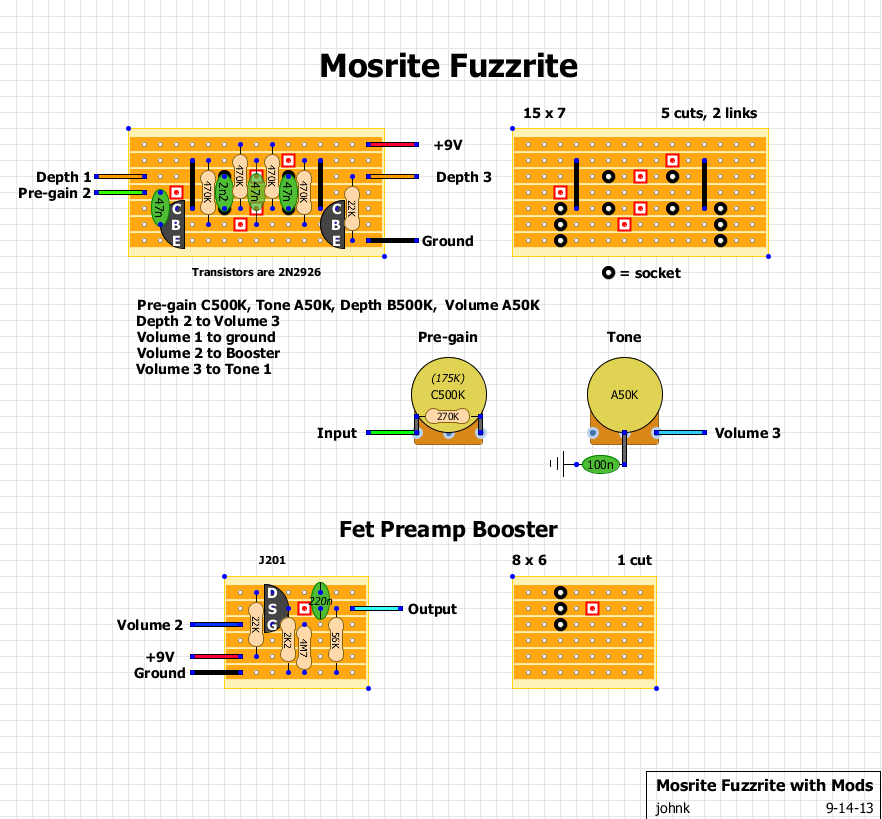
I ended up ripping the guts out of my Green Spirit (RFNR Green Bomb) and replacing it with a true Fuzzrite and then added the mods recommended by John Kallas. These are basically
  1. 22k resistor from 2n2 tone cap to ground.
  2. An extra TONE pot with a 100n cap to control the highs (seems that I like this pot cranked most of the time).
  3. An added J201 gain stage to bring the volume back up at the end of the circuit so you easily get unity volume.
  4. A higher cap value on a switch so that the DEPTH/FUZZ pot can yield fuller and fatter sound.
  5. An extra pot for PREGAIN which helps getting the sound of a lowered guitar volume knob.

The John Kallas version can be found here:

And, of course, it is always worth to visit the great layouts by Mark and Mirosol on TagboardFX blog: http://tagboardeffects.blogspot.co.il/2010/07/mosrite-fuzzrite.html


That's what I really love about building fuzz circuits. Getting the best possible design is part of the fun. So now I have a new Green Spirit, named after Greenbaum and his Spirit in the Sky guitar tone. I could have easily found 10 different names for that pedal based on the words Hoodoo, Seeds, Ventures, Misirlou, Spaghetti Westerns, Devil's Rumble and the list goes on.

In the demo below I simply played around with the knobs to get some of the tones I was looking for. 2 2N222A trannies were used because the original 2N2926 NPN trannies haven't arrived yet and I couldn't wait. A tele and a VOX AC30 cab sim at both ends of this wonderful beast with some added fender '63 style spring reverb. 

Don't miss out on this one. If you have to build one fuzz to rule them all, one fuzz for all your crazy 60's aspirations, one fuzz - grainy and harsh, buzzy and saxy, zippy and gnarly then this is IT !!! Even the "Satisfaction" riff sounds amazing with this pedal. Don't believe me? check out the demo and skip to 14:36.


Friday, December 13, 2013

Fuzzquest shares Joe Gore's Fuzz detective video

Wow....I just have to share this video as this guy is on a true fuzz quest for 60s Germanium mayham. Take 12 pedals and play the same chain and same riffs, chords, whatever so that you can actually understand the different attitude of each one. I love the extra stuff he puts as what each fuzz was famous for and some of the famous riffs recorded with it.

Check out his blog and his other related videos. Great job!

Monday, December 9, 2013

Silicon Tone Bender mkII: Revisited

The Led Bender
This is the first time I am revisiting a pedal and rebuilding it all over again. As you probably already know, the Tone Bender is one of the most elusive and tricky fuzz pedals around. The Germanium versions are hard to bias and you have to order specially selected transistors. This is not all that difficult once you understand how to measure hfe (gain) and leakage. Nevertheless, I have never built a true vintage Germanium Tone Bender and when I do, it will probably be a Prescription Electronics Yard Box or a true MK I version.

Anyway, I let the first Led Bender go and now it is happily crushing stages around the Zurich area with a really great band called Rivercash. I couldn't live without it so I had to build another one, and again, I tried starting out with the regular silicon versions which are running around the web. What can I say? another flop. No version sounded good and I couldn't understand why. The next thing I did was go back to the Hot Silicon version which sounded so well with my first Led Bender build. Voila...like magic. Wonderful buzz fuzz duzz muzz nuzz.

http://fuzzquest.blogspot.co.il/2012/11/bending-your-tone-for-page.html

I re-checked some of the biasing issues and ended up going closer to the Yard Box version with the 3.3k resistor attached to the Fuzz pot. All other biasing resistors seemed OK. Next, I changed the input capacitor on the FAT switch from 10uF to 100nF to get the Yard Box input cap. Transistors, as before Q1 and Q4 low gain 2N2369. Q2 2N3904 or some other medium gain tranny. Q3 BC108 or other medium gain tranny. I also tried 2N222A at Q3 and it was equally great. The tone knob was reversed so that cranking it would enable a fuller tone and CCW would make it thin and nasty.

The real magic with this pedal is on the lower settings of the Fuzz/Attack pot. Between 0 and 4 (on a 1 to 10 scale), the fuzz has some really great sounding crunch with the TONE knob crancked for full body. Lowering the guitar volume knob a little gives you some great unheard overdrives.

Here are some gut shots:


And about the artwork: I started with the Gold Glitter BB1590 from Mammoth and started painting using the same concept of the Zoso sign from Jimmy Page and added the other Zeppelin symbols around the sides, and of course, my ZUS logo which really complements the Page Zoso.


So, don't let this one go unbuilt. It's silicon, so it's guaranteed to deliver. And you know the best thing? When I hooked it up in front of a silicon Fuzz Face? AAAAmmmmaaazzziiing tone. You can really dial those Stoner Rock, Doom, Garage, Noise Grunge, Psychedelic Heavy Rock sound.

Probably one of my top 5 fuzz combinations!

Fuzz On.


Saturday, October 5, 2013

The Real Muff Pie


The Big Muff Pi clone
OK, you guys, we are very close to getting FuzzQuest blog on a climax this time.

If I had to choose 3 fuzz pedals to achieve the widest spectrum of fuzz sounds I would say that the 3 top pedals would be the Maestro Fuzz Tone, The Fuzz Face and the EHX Big Muff Pi (of course I could have chosen 3 other pedals if you asked me that question tomorrow morning). The Maestro Fuzz Tone is what you would call an early fuzz sound (1962-1966), similar in many ways to the early Tone Benders, raspy, buzzy, noisy and grainy like the Fuzzrite, Orpheum and the Super fuzz. The Fuzz Face is the legendary Hendrix or Gilmour fuzz sound (1967-1973), very fat, smooth and much heavier. However, when you take fuzz a step  further (1971-2013) into metal, doom, grunge, acid blues and other heavy rock forms, there is one fuzz to rule them all. It's almost the end of the journey for you if you are after that kind of sound. After that you can maybe chain 2 fuzz pedals in a row, have boosters in front, make some mods to the design, but it doesn't really get any heavier than this (there are some attempts, though...).

The Big Muff Pi pedal is the holy grail of fuzz pedals for many rock guitarists. It's very much like the Tube Screamer in its legendary reputation. Both designs were pretty simple and became the source for numerous versions, clones, re-issues and variants. Both designs became cornerstones in rock history and made a huge impact on the development of rock and guitar sound. You could say that the Tube screamer is the overdrive in the same way that the Big Muff is the Fuzz pedal and it's what many people would describe as the sound of fuzz, without going into details too much.

The Big Muff designed by Bob Myer and Mike Matthews was originally based on the earlier designs of fuzz pedals heavily used by the late great Jimi James, a.k.a. Jimi Hendrix, and was first issued in NYC around 1969. The fuzz that roared out of this pedal was so thick, rich, creamy and heavy that once people started using it, there was no way back. The name Big Muff with the PIE sign is obviously a sex related name (see the 22/7 fuzz post on this blog), based on the association of the word muff pie (oh boy) with the words fuzz, fuzzy, fuzz face and the general habit of pedal designers to name pedals after sexist male associations (Ever heard of the Merkin fuzz?). The pedal retained sound consistency due to the use of Silicon transistors and the use of 4 of them meant you had a buffer pre gain stage, a dual gain stage similar to older designs and an active tone control. Luxurious design! throughout the history of this pedal, various transistors and a lot of the passive parts values changed. Sometimes for getting different sound, but mostly due to changes in the parts inventory of the factory at the time. This resulted in a huge amount of variants. The most famous versions became the Triangle (for the arrangement of the knobs) which is the original design with its silver enclosure, the Ram's Head version which had slightly different values and transistors, the Green Russian made in Russia during the mid-90s with its famous khaki army-like enclosure and the 1977 V4 design with its red and black graphics which became the most famous graphical design for the big muffs re-issues.

Below are two images of typical BMP versions from various eras:
The USA designs from the late 60s through the 70s and the re-issues of the 90s and the 21st century

The Russian designs from the 90s

It would be redundant to go deep into the history and circuit design of this beast of a pedal as there is so much info on the web already. Just take a look at:
or

a quick version review can be found on:

On these pages you can find anything from the transistors used on each design, the schematic nuances, the enclosure changes and the artistic graphic designs. Who played what is also probably very interesting for many people. Hendrix used the original version during in his late career, Gilmour started using Big muffs around 1975-1976 and later on. He used the original Triangle version and the Violet and Ram's Head version from the early 70s .Billy Corgan and his Pumpkins used a 1978 op-amp version from 1978 in the Siamese Dream album. 8 tracks of muffed guitars at once all through a Marshall JCM800 with a Strat or a Les Paul. "Huge Huge Sound" was what Billy called it. After the album came out the price of a BMP pedal sky rocketed from 40 bucks to 200 bucks!!! What a comeback. J. Mascis of Dinosaur Jr. and Witch used a lot of early BMP versions throughout his career. He likes to put two in a row for super thunderous muff sound. Jack White of the White Stripes has used the BMP quite extensively although he is also known for using a lot of early fuzz pedals as well. 

A huge list of BMP users can be found on:
http://www.kitrae.net/music/big_muff_users.html
The list includes so many names it's hard to count but just to name a few: Robert Fripp (Guild Foxey Lady 1972-1974), Steve Howe of Yes (Triangle), Thurston Moore and Lee Renaldo of Sonic Youth (Sovtek "Civil War"), Kurt Cobain of Nirvana, John Frusciante of Red Hot Chilli Peppers, The Edge of U2, Pete Townshend of The Who, Dan Aurbach of the Black Keys, Kevin Shields of My Bloody Valentine, Jamie Cook of Arctic Monkeys, Cliff Burton of Metallica, Ace Frehley of Kiss, Jeff Pinkus and Paul Leary of the Butthole Surfers, Stephen Malkmus of Pavement and many many others. 

The ZUS Pi
Enough of the Big muff stories and on to the DIY clone build: My build was made with a wedged enclosure and a circuit design very similar to the Violet Ram's Head BMP from 1973, the early Guild Foxey Lady and also similar to the transistor V4 design from the 1977-1978 era. These versions were known for their use of the 2N5133 transistors. In fact the importance of these trannies is most crucial for the sound on Q2 and Q3. Q1 and Q4 are less critical so I used BC238 trannies which are medium gain trannies. The knobs are chicken black and the 3PDT switch enables true bypass. The sound is pretty amazing, rich and smooth fuzz on any setting. The TONE is super effective and on different areas really changes the sound of the fuzz, it's not the regular passive hi-cut we know from other designs. This is why the BMP tone stack became so popular and was implemented in so many different pedals. The SUSTAIN sounds dull on the minimum setting but anywhere above it is absolutely fuzz-a-licious. I used orange rooster knobs and painted the wedge enclosure with some flame-like brush strokes.

Build any of the versions as shown below:
or:
or:

What a huge selection of schematics, hu? Triangle or Ram's Head if you want vintage style. op-amp if you want the Smashing Pumpkins sound, Civil War or Green Russian for that grungy alternative rock sound. This is a monster fuzz any way you build it. Stack two in a row or one with an overdrive behind it or a fuzz face style pedal in front of it and you can get all sorts of fuzz bliss.

Here are some noises I made with my version:


Friday, September 20, 2013

Ginger Bread Bass. Hot from the oven

It has has been a while since I revamped my bass sound palette. I have been using bass fuzzes, distortions and filters of all kinds and I was pretty satisfied. I love the RAT clone on bass giving me the Kim Gordon, Sonic Youth style. I love the Mu-Tron III or the Tri-Vibe (Uni-Vibe) on bass for some really wacked synthy filtering sounds, and I always sleep well after a night out with a Big Muff, Germanium Fuzz Face or Fuzzrite for killer chain-saw bass riffs. One thing I never got was that sweet overdrive of those old Ampeg amps. Even the Runoffgroove Flipster was not a constant lodger on my rig since I was just not using it enough although it sounded pretty strong and biting. When Runoffgroove came out with the Ginger circuit and stated that it was an improvement over the Flipster, I couldn't resist and it has been sitting on my wish list for over a year.
The original 1965-1971 Ampeg SB-12 Portaflex.
A 12" recording work horse.
Well I finished it and ordered the most beautiful ginger-sparkly-rust enclosure on Mammoth Electronics. When I first played it I knew that it will most definitely replace the Flipster on the bass rig and that just maybe I found that 60's bass sound I love so much. Moreover, what really stunned me was the great overdrive sound it gave me on my electric guitar with humbuckers. Wow, if you want to drive your guitar with some heavy bass fuzz riffs, this unit can really complement a good fuzz for ultra pumping riffs.

The Project itself was not difficult and the noise was not enough to go and replace the trimmers with fixed resistors once you bias the 2N5457 Q1 and Q2. In fact, I always socket my trannies so that I can replace them or test a few before settling down. I did have to troubleshoot a bit. On the first attempt to bias Q1 I realized that the trimmer does not change the drain voltage at all. I found out the circuit ground was not connected. What a shame. Then I saw it still didn't work after I connected the ground. Found out another connection was not properly soldered or was it a cold soldering case? I don't know but once the little troubleshooting was done I was in bass heaven for about an hour until I realized it was 2 in the morning.

This build certainly got me going berserk on my bass all over again and that's what I like about it. I don't have a fender P-bass or a J-bass but I am convinced that this pedal sounds even better on fender basses than it does on my Music-Man style bass.


The schematic, and pref-board layout which I love so much from Runoffgroove can be found here. It's too bad the guys over there at Runoffgroove have stopped publishing layouts. I really dig their designs and so does anyone I know. I just might print a T-shirt with a "holler" to bring them back to earth.


Saturday, July 27, 2013

Thy Last Screamer

Landgraff's Tube Screamer Clone
Well, this was about to happen sooner or later. Once I started this blog I knew that one day I will build a Tube Screamer clone or something like it. However, I never, in my life, would have imagined that I would spend so much time choosing the best version for me and I sure never imagined that there were so damn many versions, variants and clones all built around the same basic topology. The original design was developed by S. Tamura in the late 70's for Ibanez and was issued after a few pilot versions as TS-808 in 1979. 

The schematic basically revolves around the operational amplifier which is hooked up with a diode clipping pair on the negative feedback loop. This is the overdrive section which is very common to all Tube Screamer offsprings. When the diodes go into clipping due to a drop in the forward voltage on the diodes, you get a saturated clipping tone. This is what happens when you crank the DRIVE knob. It increases the gain on a resistor hooked up in parallel to the clipping diodes and thus more juice is fed through to clipping. Various designs of clipping pairs can be used like 1N914 or LED pairs. Clipping can be symmetrical or asymmetrical. It means that if you run a sine waveform through the gain stage you get a distorted waveform which looks more like a  rectangular shape. There is also a clever chain of filters designed to get rid of some bass before clipping occurs and then stage.


Below you can find a schematic of the two stages: The clipping stage with its high-pass filter in front, and the post clipping EQ'ing. 


The clipping stage with its high-pass filter in front, and the post clipping EQ'ing with its lo-pass and hi-pass shelving filter.

The filter design is what makes the Tube Screamer cut so well through the mix and it always sound punchy. it's very mid range in terms of equalization. Also the original TS and most of its variants employ an input and output buffers. So, to sum things up the Tube Screamer overdrive style is a very sweet and warm one with plenty of mid-range not a lot of body. The complexity and success of its design made it possible to get a lot of different colors by implementing small changes to the circuit. A lot about the magic within the electronics can be learned from the links below:

Among the endless list of clones and variants you can find: BOSS OD-1, MJM Phantom Overdrive, Landgraff Dynamic Overdive, Green Machine, Little Green Wonder, MAXON 808, Retro Sonic eight o eight, Signa Drive, Maxon OD820, HBE Power Screamer, Toadworks Texas Flood, Visual Sounds Route 66, Xacttone Multi Drive, SBN Lil Screaming Eagle, Pedalworx Tejas, Lovepedal Burst Eternity, Cusack Screamer, Way Huge Green Rhino, Clay Jones OD, Fulltone Fulldrive 2, Love Pedal OD11 and many others, all categorized under the tedious label YATS (Yet Another Tube Screamer).

Scream-a-delic Dynamic Overdrive
After listening to loads of Youtube videos and reading endless reviews and recommendations I built the basic "skeleton" similar to the Runoffgroove "Tube Reamer" and started experimenting with various designs. I ended up really loving the versatility and tone of the Landgraff Dynamic Overdrive (LDO) which became sort of legendary, maybe because it was a boutique and expensive pedal, but maybe because it just sounds fantastic. I don't know. Anyway this baby rocks so well that I ended up giving it to our band's guitarist and he doesn't plan on giving it back to me. Along with the Boss BD-2 and a Wah-wah in front he has the most creamy and sweet sound you can imagine.  

I built the layout using the JRC4558D op-amp and a pair of 2SC1815 trannies for the buffers. A really nice addition by Landgraff is the clipping switch which let's you choose between symmetric LED clipping, asymmetric diode clipping (1N914) and no clipping at all which makes the unit act as a nice mid range booster. I didn't use any ready made layout and just built the entire thing according to the schematic from beginning to end. Got it right the first time...
If you want to imagine the sound of the screamer think of the SRV blues tone and the sweet Gibson sound of R.E.M. or Oasis. That's the sound. Being such a big psychedelia addict I named it "SCREAM-A-DELIC" to stay in context with the original Screamer but to give it some nice Scottish Primal Scream vibe (and yes, I noticed that I miss spelled the "Scream"...ooops).

Until I get my audio clip together, here's a review from the best in the business - the Gearmanndude. He's got a few of those videos featuring the LDO amd it's a killer pedal, even next to some boutique legends like the Zendrive and the original screamers.


Don't think twice. Built the LDO or another YATS, and yeah, it is that good! You can find the Clay Jones schematic with a nice layout here or here.